

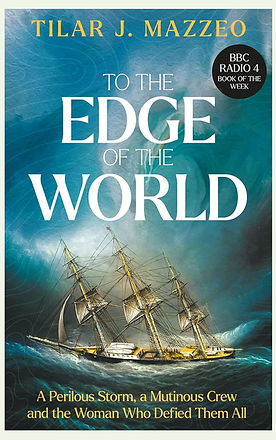
Tilar J. Mazzeo
To the Edge of the World
Nowadays, Mary Ann Patten is an entirely forgotten figure, but in the late 1850s and 1860s, her fame spread briefly from the coasts of New England across America and the seafaring world. To the Edge of the World tells the story of her astonishing courage and resolution in saving her husband Joshua’s command, the clipper Neptune’s Car, from a ferocious storm in the seas south of Cape Horn. She was a mid-nineteenth-century heroine, an American Grace Darling or Florence Nightingale, in a maritime world dominated by men.
Neptune’s Car sailed from New York on 1st July 1856, bound for San Francisco, China and London, a voyage fraught with danger but promising huge rewards should all go well. She was commanded by Joshua Patten, who at twenty-nine was a skipper with a growing reputation for the skill and boldness of his seamanship. Neptune’s Car, launched in 1853, was an ‘extreme’ clipper, the very latest in maritime technology in the final years of the age of sail.
This was Joshua Patten’s second circumnavigation in command of Neptune’s Car and the second time his wife Mary Ann had accompanied him. When the clipper set sail from New York, Mary Ann was just 19 years old and in the early stages of pregnancy. If their first circumnavigation in Neptune’s Car had been relatively uneventful, the second was a disaster. The first mate, William Keeler, was demoted for insubordination, leaving Joshua to shoulder a greater burden in sailing the ship. By the time Neptune’s Car reached the Southern Ocean, Joshua had lapsed into a state of delirium. With her husband incapacitated, Mary Ann assumed command of the clipper as she sailed into a ferocious storm south of Cape Horn. It was only her cool-headedness and skill which saved the ship from the storm and, later, from icebergs.
To the Edge of the World is an entertaining book, offering the reader much collateral information alongside the principal story. Thus, for example, we learn about the commercial and financial arrangements which underpinned the age of the clipper. Its American author, Tilar J. Mazzeo, a former academic, describes herself as a writer of ‘narrative nonfiction’, a genre which seems to combine the disciplines of conventional history and the inventive freedom of fiction. In practice, this allows the author to fill any lacunae in the historical record with generic descriptive and explanatory material. Without these fillers, Joshua and Mary Ann Patten’s story would be a good deal shorter but less informative and historically engaging.
Richard Hopton
Elliot & Thompson